


Introduction
Men’s skin is biologically different from women’s skin, and that distinction matters more than most guys realize. Higher testosterone levels make male skin approximately 25% thicker, produce more sebum, and create unique concerns that range from daily shaving irritation to accelerated collagen breakdown after the age of 35. The best skincare products for men are built around those realities, not recycled formulas with blue packaging.
This guide cuts through the noise. Whether you are building your first routine or tightening up an existing one, everything you need is here — organized by product category, skin type, ingredient science, and the shaving-specific skincare advice that most guides completely skip.
Why Men’s Skin Needs a Different Approach
Before picking products, it helps to understand what you are actually dealing with. Male skin produces more oil, meaning pores clog faster and breakouts are more persistent. The skin barrier is more resilient in younger years but loses collagen at a faster rate after middle age. On top of that, the physical act of shaving creates micro-abrasions on the face two to seven times per week — a stressor women’s skincare routines simply do not account for.
The biggest mistake most men make is treating skincare as an optional luxury rather than basic maintenance. Skipping moisturizer because your skin feels oily, using a three-in-one body wash on your face, or ignoring SPF unless you are at the beach — these habits accelerate aging and cause preventable skin problems. The best mens skincare approach is not complicated, but it does require using the right products consistently.
How to Identify Your Skin Type Before Buying Anything
Buying products without knowing your skin type is the number one reason men’s skincare routines fail. Apply the following test: wash your face with a gentle cleanser, pat dry, and wait 30 minutes without applying anything. Then assess.
- Oily skin feels greasy across the forehead, nose, and chin. Pores look enlarged and you may notice shine in photos.
- Dry skin feels tight, sometimes flaky, especially around the cheeks and jaw.
- Combination skin has an oily T-zone with normal or dry cheeks.
- Sensitive skin reacts with redness, stinging, or itching to new products or after shaving.
- Normal skin has minimal shine, small pores, and rarely reacts to new products.
This single assessment changes every product decision you will make from here forward.
The Core Men Skin Care Products You Actually Need
The best skin care products for men are not the most expensive ones. They are the ones that match your skin type and that you will actually use every day. Here is the product-by-product breakdown.
Face Wash and Cleansers
A dedicated face cleanser is the foundation of mens facial grooming. Bar soap and body wash strip the skin’s natural lipid barrier, leading to either overcompensating oil production or prolonged dryness. A proper facial cleanser removes dirt, sweat, and dead cells without disrupting skin pH.
For oily and acne-prone skin, look for gel-based cleansers containing salicylic acid at 0.5% to 2%. Salicylic acid penetrates the pore lining, dissolving the debris that causes blackheads and breakouts. CeraVe Foaming Facial Cleanser and the CeraVe Renewing SA Cleanser are both reliable, widely available options in this category.
For dry or sensitive skin, cream and lotion cleansers are gentler. Look for ceramides and glycerin on the ingredient list — ceramides reinforce the skin barrier while glycerin draws moisture in. La Roche-Posay Toleriane Hydrating Gentle Cleanser is a strong choice for sensitive types.
Cleanse twice daily, morning and evening. In the morning, cleansing removes overnight sweat and prepares skin for product absorption. In the evening, it clears pollution, oil, and residue accumulated throughout the day.
Moisturizers for Men

Many men skip moisturizer, particularly if they have oily skin, reasoning that adding more moisture to already-shiny skin makes no sense. This is a misunderstanding of how skin works. Oily skin is often dehydrated skin, meaning the skin is lacking water, not oil. When water levels drop, sebaceous glands produce more oil to compensate. A lightweight, oil-free moisturizer corrects that cycle.
For oily skin: Gel or water-based moisturizers work best. Look for niacinamide at 2-5%, which studies show reduces sebum production, minimizes pore appearance, and strengthens the barrier simultaneously. The Ordinary Niacinamide 10% + Zinc 1% Serum or Paula’s Choice RESIST Weightless Advanced Repairing Toner are excellent starting points.
For dry skin: Richer creams containing hyaluronic acid, shea butter, or ceramides provide sustained hydration. CeraVe Moisturizing Cream is an outstanding value for dry and sensitive types.
For combination skin: Zone-specific application works well — lighter gel on the T-zone, slightly richer formula on drier cheeks and jawline areas.
Apply moisturizer while skin is still slightly damp from cleansing to lock in hydration more effectively.
Sunscreen — The Most Underused Men’s Skincare Product
Men are significantly more susceptible to melanoma than women, yet consistently the most likely to skip daily sunscreen. UV exposure is also the single largest external driver of premature aging — responsible for up to 80% of visible facial aging including fine lines, dark spots, and loss of elasticity.
The best sunscreen for daily face use should be:
- Broad-spectrum (protecting against both UVA and UVB rays)
- SPF 30 minimum, SPF 50 for extended outdoor exposure
- Lightweight and non-greasy so you will actually wear it
For men who dislike the feel of traditional sunscreen, a moisturizer with built-in SPF is the easiest solution. EltaMD UV Clear Broad-Spectrum SPF 46 is a dermatologist-recommended option specifically formulated for skin prone to acne and redness. For something more budget-friendly, Neutrogena Hydro Boost Water Gel Lotion SPF 30 offers a clean, non-sticky finish.
Sunscreen applies last in the morning routine, every single day — not just when the sun is visible.
Serums: Targeted Treatment Products
Serums are concentrated, active-ingredient formulas that address specific skin concerns more effectively than moisturizers can alone. They are not mandatory for a basic routine, but they are where meaningful results come from for men dealing with aging, dark spots, or chronic oiliness.
Vitamin C serums brighten dull skin, reduce post-acne hyperpigmentation, and boost collagen synthesis. Apply in the morning for antioxidant protection against pollution and UV damage. The CeraVe Skin Renewing Vitamin C Serum and SkinCeuticals C E Ferulic are among the most studied formulations in this category.
Hyaluronic acid serums are a lightweight hydration option that works for every skin type, including oily. Hyaluronic acid holds up to 1,000 times its weight in water without adding any oil to the skin. The Neutrogena Hydro Boost Hyaluronic Acid Serum is a strong entry-level option.
Niacinamide serums multitask — reducing oil, fading hyperpigmentation, calming redness, and reinforcing the skin barrier. It is one of the most versatile ingredients in men’s skincare.
Apply serum after cleansing but before moisturizer to allow active ingredients to absorb into the skin rather than sitting on top of a moisturizing layer.
Retinol and Anti-Aging Products for Men
Retinol is the most clinically supported ingredient for reducing visible signs of aging. It accelerates cellular turnover, stimulates collagen production, minimizes pore appearance, and smooths fine lines over consistent use. It is particularly relevant for men over 30, as male skin starts losing collagen more rapidly after this point.
Start with a low concentration — 0.025% to 0.1% — and apply only at night, every other day initially. Skin needs time to adapt. Common beginner-friendly options include RoC Retinol Correxion Line Smoothing Serum and Neutrogena Rapid Wrinkle Repair Retinol Oil.
Important: always apply sunscreen the morning after retinol use. Retinol increases photosensitivity, and skipping SPF while using retinol will counteract any anti-aging benefit.
For men who experience irritation from standard retinol, bakuchiol is a plant-derived alternative that delivers similar collagen-stimulating effects without the same sensitivity risk. It works particularly well in combination skin and sensitive skin types.
Eye Creams for Men
The skin under and around the eyes is the thinnest on the face and shows the first visible signs of aging and fatigue. Dark circles, puffiness, and crow’s feet all develop here earlier than anywhere else. Most general moisturizers are too thick to properly penetrate this delicate area.
A dedicated eye cream with caffeine addresses morning puffiness by constricting blood vessels and improving microcirculation. Niacinamide and peptides address long-term concerns — peptides stimulate collagen and elastin production, while niacinamide strengthens the under-eye barrier to prevent moisture loss. Brickell Men’s Restoring Eye Cream combines both caffeine and peptides in a formula designed specifically for men’s facial products.
Apply eye cream using the ring finger — the weakest finger — with a gentle patting motion. Never rub or drag, as this accelerates the very wrinkling you are trying to prevent.
Exfoliators
Shaving provides some degree of mechanical exfoliation, which is one reason men’s skin often looks naturally smoother than expected. But shaving only covers the lower face. Chemical exfoliation 2 to 3 times per week benefits the entire face, clears built-up dead cells, improves the effectiveness of other products applied afterward, and helps prevent ingrown hairs.
AHAs (alpha-hydroxy acids) like glycolic acid and lactic acid work on the skin’s surface, improving texture, brightness, and fine line appearance. They are ideal for normal to dry skin types.
BHAs (beta-hydroxy acids) like salicylic acid penetrate into the pore, making them the better choice for oily, acne-prone, or combination skin.
Never exfoliate immediately after shaving. Freshly shaved skin is sensitized and micro-abraded — introducing a chemical exfoliant at this point causes significant irritation. Instead, exfoliate on rest days or evenings after shaving has fully settled.
Shaving-Specific Skincare — The Missing Section Most Guides Ignore
Shaving is a skincare event, not just a grooming task. Every time a blade passes across the face, it removes a thin layer of the stratum corneum — the outermost skin barrier. Done with the wrong products or poor technique, this damages the barrier, triggers inflammation, and creates conditions for ingrown hairs, razor burn, and chronic redness.
Pre-Shave Preparation
Always cleanse before shaving. Warm water or a hot shower opens pores and softens beard hairs, reducing the resistance the blade encounters. Hydrated hair cuts far more cleanly than dry hair, significantly reducing nicks and irritation.
Choosing the Right Shaving Cream or Gel

Avoid aerosol canned shaving foams that contain denatured alcohol, sodium lauryl sulfate (SLS), isobutane, and synthetic fragrance. These ingredients strip the skin’s protective lipid layer, increase razor drag, and leave skin tight, red, and reactive — particularly in men with sensitive or acne-prone skin.
Instead, look for shaving creams and gels formulated with:
- Aloe vera for anti-inflammatory and soothing effects
- Shea butter or glycerin for lubrication and moisture retention
- Hyaluronic acid for barrier hydration during the shave
- Fragrance-free formulations for sensitive skin types
Shaving Technique That Protects Skin
- Always shave with the grain of hair growth on the first pass to minimize friction
- Use a sharp, clean razor — dull blades tug at hairs rather than cutting them cleanly, creating irritation and ingrown hairs
- Replace blades after every 5 to 7 shaves
- Avoid pressing hard against the skin — blade pressure increases irritation without improving closeness
Post-Shave Recovery
This is where most men cut corners. Post-shave skin needs two things: soothing and barrier restoration.
Aftershave products containing alcohol provide the familiar sharp tingle, but that sensation is actually barrier damage occurring in real time. Alcohol evaporates skin moisture and delays healing of minor shaving microcuts.
Better alternatives include:
- Alcohol-free aftershave balms or gels containing aloe vera, chamomile, or cactus extract to reduce redness and calm inflammation
- A lightweight moisturizer applied immediately after shaving to restore lost hydration
- Witch hazel (non-alcohol formulation) as a pore-tightening toner that disinfects without drying
Men’s Skincare Routine by Skin Type
Morning Routine
| Step | Oily/Acne-Prone | Dry/Normal | Sensitive |
|---|---|---|---|
| Cleanser | Gel cleanser with salicylic acid | Hydrating cream cleanser | Fragrance-free micellar or cream cleanser |
| Serum | Niacinamide serum | Vitamin C or hyaluronic acid serum | Hyaluronic acid serum |
| Moisturizer | Lightweight oil-free gel | Rich ceramide moisturizer | Fragrance-free ceramide moisturizer |
| Sunscreen | SPF 30-50 broad-spectrum | SPF 30-50 broad-spectrum | SPF 30-50 mineral sunscreen |
Evening Routine
| Step | Oily/Acne-Prone | Dry/Normal | Sensitive |
|---|---|---|---|
| Cleanser | Gel or foam cleanser | Cream cleanser | Gentle micellar cleanser |
| Treatment | Retinol (every other night) | Retinol or peptide serum | Bakuchiol or peptide serum |
| Eye Cream | Caffeine + niacinamide eye gel | Peptide-rich eye cream | Fragrance-free peptide eye cream |
| Moisturizer | Lightweight gel or lotion | Rich barrier cream | Ceramide and glycerin cream |
Key Skincare Ingredients for Men: What They Do and When to Use Them
| Ingredient | Primary Benefit | Best Skin Type | Use AM or PM |
|---|---|---|---|
| Niacinamide | Reduces oil, strengthens barrier, fades dark spots | Oily, combination, all types | AM or PM |
| Hyaluronic Acid | Deep hydration without adding oil | All types, especially dry | AM and PM |
| Retinol | Anti-aging, collagen stimulation, pore minimizing | Normal to mature | PM only |
| Salicylic Acid | Pore-clearing, acne prevention, exfoliation | Oily, acne-prone | AM or PM |
| Vitamin C | Brightening, antioxidant protection, collagen support | All types, especially dull skin | AM |
| Ceramides | Barrier repair, moisture retention | Dry, sensitive, compromised barrier | AM and PM |
| Peptides | Collagen stimulation, firming, anti-aging | Mature, normal, sensitive | AM or PM |
| Glycolic Acid | Surface exfoliation, smoothing, brightening | Normal to oily | PM (2-3x weekly) |
| Caffeine | Reduces puffiness, dark circles | All types | AM (eye cream) |
| Bakuchiol | Natural retinol alternative, anti-aging | Sensitive skin | PM |
Budget vs Premium: Comparing Mens Facial Products Across Price Points
One of the most persistent myths in men’s skincare is that expensive products work better than affordable ones. The ingredient science does not support this. What matters is whether the formulation contains proven actives at effective concentrations — and that is entirely independent of price.
| Category | Budget Option | Mid-Range Option | Premium Option |
|---|---|---|---|
| Cleanser | CeraVe Foaming Facial Cleanser | Kiehl’s Ultra Facial Cleanser | Tatcha The Rice Wash |
| Moisturizer | CeraVe Moisturizing Cream | First Aid Beauty Ultra Repair Cream | La Mer Moisturizing Cream |
| Sunscreen | Neutrogena Hydro Boost SPF 30 | EltaMD UV Clear SPF 46 | Supergoop! Unseen Sunscreen SPF 40 |
| Retinol | RoC Retinol Correxion Serum | Paula’s Choice 1% Retinol Serum | SkinMedica Retinol 0.25 Complex |
| Eye Cream | Neutrogena Rapid Dark Circle Repair | Brickell Restoring Eye Cream | Clinique For Men Age Defense Eye Cream |
For beginners building from scratch, a strong $40-60 investment in a CeraVe cleanser, moisturizer, and a drugstore SPF will outperform a $200 premium bundle that sits unused in a drawer. Consistency matters infinitely more than cost.
Lifestyle Factors That Impact Men’s Skin Most People Miss
Skincare products work within the context of overall health, not in isolation. Several lifestyle factors either accelerate or undermine whatever routine you build.
Sleep is when the skin repairs itself. Growth hormone release during deep sleep drives cellular regeneration and collagen synthesis. Consistently poor sleep accelerates the appearance of aging and increases cortisol, which triggers oil production and inflammation.
Diet has a direct and measurable impact on skin quality. Diets high in refined sugars trigger glycation — a process where sugar molecules attach to collagen and elastin, making them stiff and brittle. Omega-3 fatty acids from oily fish and walnuts support the skin barrier. Antioxidant-rich vegetables reduce oxidative damage from UV exposure and pollution.
Hydration is frequently oversimplified, but adequate water intake does support skin plumpness and resilience. The kidney processes roughly 2 liters of fluid daily; what is left reaches the skin last in the body’s priority system. Topical hyaluronic acid supplements this, but it does not replace internal hydration.
Exercise improves circulation, which delivers more oxygen and nutrients to skin cells and promotes more efficient waste removal. Post-workout, always cleanse the face to prevent sweat and oil from sitting in pores.
Alcohol depletes hydration, impairs the liver’s ability to process toxins, and dilates blood vessels — leading to persistent redness and puffiness in the face over time.
Skincare for Men by Age: What Changes and When
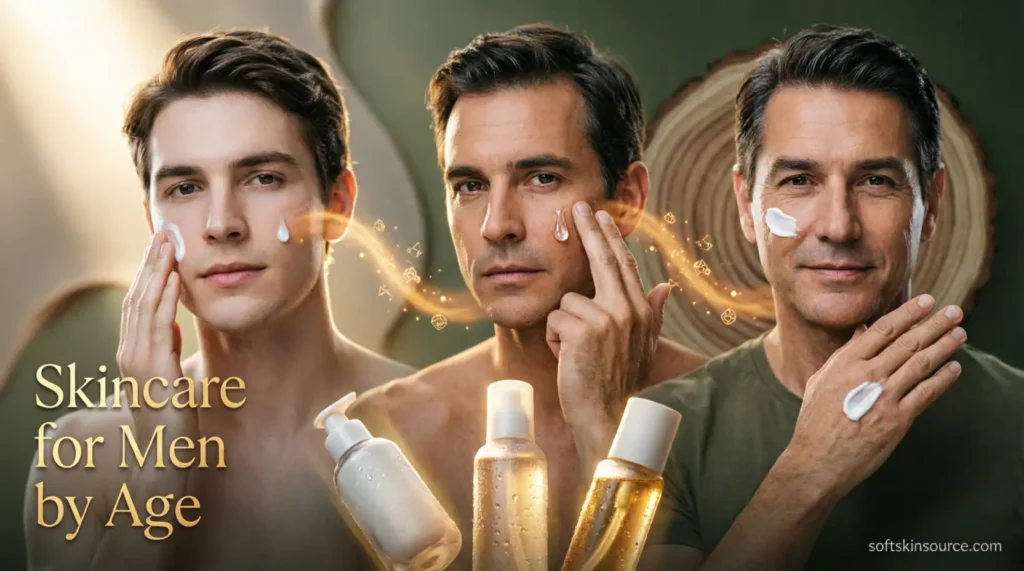
Men in Their 20s
The primary concern is usually acne, oil control, and early sun damage. A simple routine — cleanser, light moisturizer, and SPF — is sufficient. Start retinol at low concentration toward the late 20s as a preventative measure before visible aging begins.
Men in Their 30s
Collagen loss becomes noticeable, particularly around the eyes and forehead. This is when adding a Vitamin C serum in the morning and committing to consistent retinol use at night makes a meaningful long-term difference. Eye cream becomes relevant here, especially for men with demanding schedules or poor sleep.
Men in Their 40s and 50s
Skin becomes drier and thinner. Ceramide-rich moisturizers become essential rather than optional. Peptides and growth factor serums support declining collagen. SPF becomes even more critical as the skin’s natural repair mechanisms slow. Prescription retinoids (tretinoin) are worth discussing with a dermatologist at this stage, as over-the-counter retinol may not deliver the same results as prescription-strength formulations.
Men Over 60
Skin is significantly thinner, more fragile, and prone to dryness. Gentle cleansing, deeply hydrating barrier creams, and diligent sun protection are the priorities. Avoid harsh exfoliants and focus on nourishing, barrier-supportive ingredients.
Common Skincare Mistakes Men Make (And How to Fix Them)
- Using bar soap on the face. Bar soaps are typically alkaline and disrupt the skin’s natural pH, leading to dryness or reactive oiliness. Switch to a pH-balanced facial cleanser.
- Skipping sunscreen on cloudy days. UVA rays penetrate cloud cover and glass. They are responsible for the aging and DNA damage that accumulates silently year-round.
- Exfoliating right after shaving. This stacks two forms of physical and chemical irritation on already-sensitized skin. Separate these by at least a few hours or use exfoliation on non-shaving days.
- Using the same products year-round. Skin behaves differently in winter humidity versus summer heat. Oily skin in summer can become significantly drier in winter, requiring a richer moisturizer.
- Expecting overnight results. Hyaluronic acid delivers visible hydration within hours. But retinol takes 8 to 12 weeks to show anti-aging results, and sunscreen’s benefit accrues over years. Patience and consistency are not optional.
- Ignoring the neck and chest. The neck ages at the same rate as the face, and receives comparable UV exposure. Extend your routine downward.
- Applying products in the wrong order. Correct order is: cleanser, toner (if used), serum, eye cream, moisturizer, sunscreen (morning only). Thinnest to thickest consistency allows each product to absorb properly.
Frequently Asked Questions
Do men really need different skincare products than women? Men’s skin is measurably different — thicker, oilier, and subject to shaving-related stress. While many unisex products work perfectly well, formulas specifically designed for mens facial products tend to address these differences more directly. The most important thing is that the ingredients match your skin type, regardless of how the product is marketed.
What is the minimum skincare routine a man should follow? A cleanser, a moisturizer, and a broad-spectrum SPF 30 sunscreen covers the essentials. These three steps, used twice daily (minus sunscreen at night), address cleanliness, barrier health, and the leading external cause of skin aging.
How long does it take to see results from a new skincare routine? Hydration improvements often appear within 48 to 72 hours. Acne may improve within 4 to 6 weeks. Anti-aging results from retinol require 8 to 12 weeks of consistent use. Give any new routine at least one full month before evaluating whether it is working.
Can men use women’s skincare products? Yes, most active ingredients work identically regardless of gender. Hyaluronic acid, niacinamide, retinol, ceramides, and SPF all deliver the same results. The practical difference is that some women’s formulas include fragrance or are designed for thinner skin textures, which may underperform on the thicker, oilier characteristics common in male skin.
Should men with oily skin use moisturizer? Absolutely. Oily skin is frequently dehydrated skin, meaning the surface lacks water, not oil. When the skin is dehydrated, sebaceous glands increase oil production as compensation. A lightweight, water-based, oil-free moisturizer corrects this cycle without adding greasiness.
When should a man start using retinol? Late 20s to early 30s is the ideal time to begin. At this stage, collagen loss is just beginning and retinol use at low concentrations prevents and delays visible aging rather than trying to reverse it. Starting earlier means the treatment works with your skin’s still-efficient repair mechanisms.
Is sunscreen necessary every day, even indoors? UVA rays — the type most associated with aging and long-term DNA damage — penetrate glass. If you sit near a window during daylight hours, you are receiving UVA exposure. Daily SPF application, even on work-from-home days, is a meaningful long-term investment.
How do you treat razor burn and ingrown hairs? Switch to a fragrance-free, alcohol-free shaving cream. Shave with the grain on the first pass only. After shaving, apply an aloe vera gel or alcohol-free soothing balm. For recurring ingrown hairs, introduce salicylic acid exfoliation two to three times per week on non-shaving days to prevent dead skin from trapping hairs beneath the surface.
Final Thoughts
The best mens skincare routine is the one you actually commit to. It does not need to involve twelve products or an hour of your morning. Three to five consistent steps — cleanser, serum if needed, moisturizer, and SPF — will outperform a full shelf of products used sporadically.
The biggest shift men can make is treating skincare not as vanity but as preventative maintenance. The same logic that applies to exercise, nutrition, and sleep applies here: what you do consistently in your 20s and 30s determines how your skin looks in your 40s and 50s. The products exist. The ingredients are understood. The routine is simple. The only variable left is whether you start.
